
The Working Mind

Building a Culture of Psychological Safety
About half of Canadian workers have experienced mental health challenges that affected their work, yet only a third told their employer. In high-pressure workplaces, the fear of judgment or a professional setback keeps people quiet, and the people around them are left without a way to help.
The Working Mind builds what’s missing.
This evidence-based program gives your whole organization a shared, practical language for mental health, so conversations start earlier and no one has to worry about saying the wrong thing. Instead of waiting for a crisis, it helps people notice small shifts in themselves and their colleagues, and step in with empathy and confidence. The result is the psychological safety that makes it possible for people to say how they’re really doing.
For your organization, that means psychological safety built into how you work, which supports retention, sustained productivity, and fewer of the hidden costs of workplace distress.
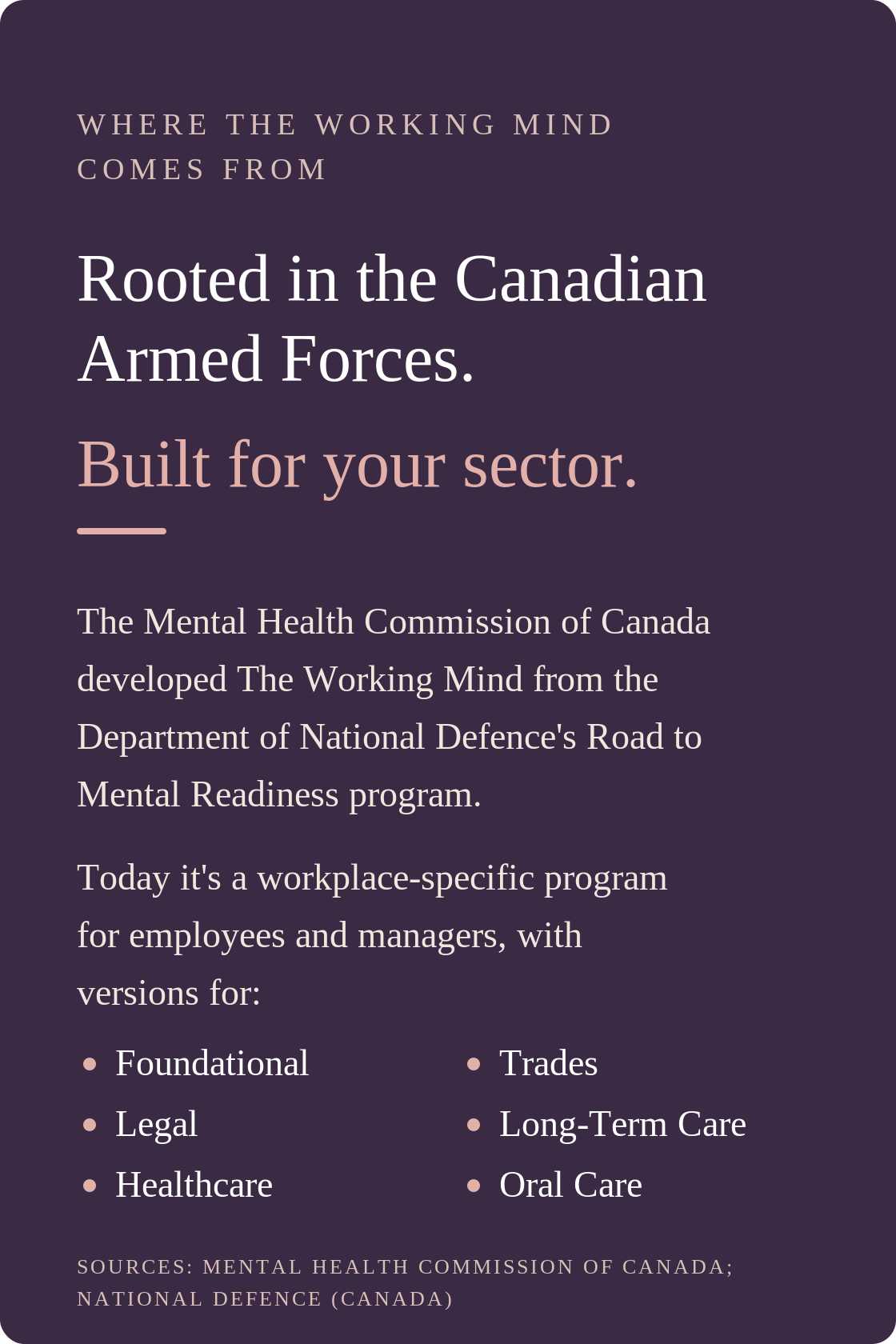
Foundational Employee

For any workplace. Builds self-awareness, reduces stigma, and gives employees a shared framework for mental health at work.
Trades

Developed in collaboration with the Infrastructure Health and Safety Association. Built for the language and culture of the trades.
Health Care Professionals
Built for the pressures and realities of healthcare environments, including the unique mental health challenges facing clinical and support staff. Developed with healthcare sector input.

The Legal Sector
Developed in collaboration with the Ontario Bar Association. Accepted for CPD credit by the Law Society of British Columbia & the Law Society of Ontario.
Long-Term Care

For teams working with older adults in residential and community care settings. Developed with the realities of LTC workplace culture at its core.
Oral Care Professionals

For dental teams and oral care professionals navigating the mental health of both staff and patients in small practice environments. Developed with oral care sector input.
Mental health isn't a soft corporate initiative. It's a core safety metric.
The Working Mind has been evaluated repeatedly. A meta-analysis of eight separate implementations found moderate reductions in stigma alongside increases in self-reported resilience and coping skills (Dobson, Szeto & Knaak, 2019). A later study of virtual delivery across six workplaces found comparable results to in-person delivery, both immediately and at three months (Dobson et al., 2025). The researchers note that a brief program is unlikely to carry indefinitely on its own, and that refresher sessions are what maintain and strengthen the effect over time.
Deloitte Canada's research on workplace mental health programs found returns that grow with time. Companies with programs in place for one year saw a median annual return of $1.62 for every dollar invested, rising to $2.18 for programs running three or more years. Both findings point the same direction. The return isn't a reward for spending more. It's a reward for staying with it.
The evidence holds regardless of sector. What it looks like in practice depends on where your team shows up, whether that's a legal office, a hospital unit, a job site, a care home, or a dental practice, which is why each version of this course is built differently.
Sources: Dobson, K. S., Szeto, A., & Knaak, S. (2019). The Working Mind: A Meta-Analysis of a Workplace Mental Health and Stigma Reduction Program. Canadian Journal of Psychiatry, 64(1_suppl), 39S–47S. Dobson, K. S., Lindsay, B., Termeer, J., Mineva, E., & Szeto, A. (2025). Reducing Mental Health Stigma in the Workplace: A Meta-Analysis of The Working Mind Program in Virtual Delivery Format. Canadian Journal of Psychiatry, 70(4), 278–288. Deloitte Canada (2019). The ROI in workplace mental health programs: Good for people, good for business.